Climate Change Manifestations: November 2025 Report
Published on November 17, 2025 | By Two-Part Plan News
Snapshots of Climate Change Manifestations: November 2025
Opening Signal
Repair begins with understanding and acknowledgement.
Only by naming the irreversibility of some tipping points can we focus on slowing cascades, protecting what remains, building resilience for what is to come — and taking proactive action to prevent additional climate tipping points from irreversibly tipping in the future. This is not only repair; it is the avoidance of pending disaster. Just because the technology exists to avoid destruction, it is not enough — will, desire, coordinated, and committed action must take place as well.
Hurricane Melissa in Jamaica
Date: October 28, 2025
Summary: Hurricane Melissa made landfall in Jamaica as a Category 5 storm with peak winds of 185 mph (298 km/h). Rapid intensification from tropical storm to Category 5 within 24 hours tied it for the strongest Atlantic‑basin landfall on record.
Human and economic impact: 45 confirmed fatalities; 15 missing. Estimated economic losses: $2–$5 billion (roughly 10–25% of national GDP). Critical agricultural areas, including St. Elizabeth Parish, were devastated, threatening food security and livelihoods.
Attribution: World Weather Attribution analyses and peer summaries link Melissa’s intensity to record‑warm ocean conditions and increased atmospheric moisture that favor rapid intensification and extreme rainfall. Attribution statements indicate higher wind speeds and substantially increased probability and intensity of eyewall rainfall relative to a pre‑industrial baseline.
Climate link: Warming oceans and higher atmospheric moisture are driving the rapid intensification and catastrophic rainfall that make storms like Melissa far more destructive for vulnerable nations.
AMOC Weakening and Sovereign Alarm
Concerns about the Atlantic Meridional Overturning Circulation (AMOC) intensified in late October and November as researchers and, notably, the government of Iceland reported mounting risks of disruption. AMOC regulates regional rainfall, trade winds, and large‑scale climate patterns; sustained weakening or collapse could trigger droughts, floods, altered storm tracks, and systemic food‑security shocks across hemispheres.
In a historic move, Iceland formally designated AMOC collapse as a national security threat and existential risk, marking a shift from scientific concern to geopolitical alarm. This reframes AMOC not only as a climate system vulnerability, but as a direct governance challenge.
Climate link: Accelerating ice melt and continued ocean warming increase freshwater input and stratification, stressing AMOC dynamics. Prevention through rapid forcing reductions is more actionable than direct restoration, underscoring the urgency of immediate emissions cuts.
Coral reefs: first climate tipping point crossed
October syntheses and the Global Tipping Points assessments conclude warm‑water coral reefs have entered widespread, self‑reinforcing decline and are crossing their thermal tipping points under current warming trajectories. Even stabilization at 1.5°C will not prevent large‑scale reef loss; only limited refugia are likely to persist without substantive global cooling.
Climate link: Coral reef collapse reduces coastal protection, fisheries productivity, and biodiversity that underpin livelihoods for hundreds of millions. As the first clearly documented global ecosystem tipping point, reef loss signals systemic risk and cascade potential.
Recent analyses indicate that parts of Greenland and West Antarctica show committed mass loss. Processes such as ice‑shelf thinning and grounding‑line retreat point toward long‑term sea‑level rise measured in meters over coming centuries, and melt pulses are extending later into autumn.
Climate link: Ice‑sheet destabilization locks in long‑term coastal impacts, increases flood risk for low‑lying regions, and alters atmospheric circulation patterns with consequences for regional extremes and agriculture.
Arctic Warming and Sea Ice Retreat
The Arctic is warming at more than four times the global average, making it one of the most affected regions on Earth. Rapid sea-ice retreat is weakening the “white cold cap” effect that reflects solar radiation, exposing darker ocean surfaces that absorb more heat. This accelerates the shift from a snow-dominated to a rain-dominated Arctic hydrological cycle, with cascading impacts on glaciers, permafrost, runoff, and ecosystems.
Key Findings
Amplified warming: Arctic temperatures rising >4× faster than global mean.
Hydrological shift: Transition from snow to rain alters soil thermal regimes and accelerates permafrost thaw.
Quantified attribution: Ensemble simulations (PAMIP/CMIP) show sea-ice retreat contributes ~30% of increased rainfall along Arctic coasts of Siberia and North America.
Mechanisms: ~70% of rainfall increase comes from warming that turns snowfall into rain; ~30% from enhanced evaporation over open water.
Feedback loops: More liquid precipitation accelerates sea-ice decline, intensifies permafrost thaw, and releases greenhouse gases, reinforcing global warming.
Regional and Global Implications
These changes create rainfall enhancement belts along Arctic coasts, threaten species such as polar bears and reindeer, and contribute to global sea-level rise and extreme climate events. The domino effect of sea-ice retreat underscores the Arctic’s role as a critical tipping element in the global climate system.
Scientific context: By separating total climate forcing from sea-ice-specific impacts, researchers established a quantitative “sea ice–precipitation” relationship, enhancing prediction capability for Arctic extremes.
Sources: Geophysical Research Letters study (2025); PAMIP/CMIP ensemble analyses; Phys.org summary of Yang Jiao et al.
Amazon rainforest: rising dieback risk
Updated assessments indicate the Amazon faces increased risk of transformation toward a savanna‑like state between roughly 1.5–2°C of warming, driven by drought, deforestation, and feedbacks that weaken regional moisture recycling. A flip from sink to source would accelerate global warming and biodiversity loss.
Climate link: Protecting and restoring the Amazon—through deforestation halts, finance for standing forest value, and Indigenous stewardship—is a frontline repair action to preserve moisture pathways and carbon stores.
Field reports from Siberia and Alaska document unprecedented rapid thaw and accelerating ground subsidence. Emerging measurements suggest methane and carbon release rates are higher than earlier model expectations; precise numerical multipliers remain under verification and are provisional.
Glacial melt and sea‑ice loss
Arctic sea ice: September 2025 recorded an annual minimum that places 2025 among the lowest years on record.
Mountain glaciers: Continued rapid mass loss in the Andes and Himalaya threatens downstream water security for large populations; Swiss Alpine monitoring projects major near‑term reductions.
Wildfires
The 2025 wildfire season was unusually severe and costly across multiple regions: Canadian boreal forests, the Mediterranean, southeast Australia, and western North America. Economic and insured losses reached very high levels in 2025; aggregated global damage estimates continue to be refined by insurers and national authorities.
Antarctic grounding‑line retreat
Observations show accelerating grounding‑line retreat in parts of West Antarctica, elevating the probability of faster future sea‑level rise.
Amazon moisture recycling
Monitoring indicates measurable declines in moisture transport capacity in parts of the basin, increasing transformation risk; specific basin‑scale percentage estimates are still being refined.
Scientific context: Multiple cryosphere and biosphere indicators are evolving faster than many earlier models predicted, increasing cascade risk among interconnected tipping systems.
COP30 in Belém, Brazil: governance at the frontline
Held Nov 10–21, 2025 in Belém to center tropical forests, COP30 emphasized limiting warming to 1.5°C, updated NDCs, adaptation finance, and forest protection mechanisms. The conference highlighted the gap between pledges and implementation and called for an “acceleration decade” of delivery.
Outcomes: stronger emphasis on adaptation, youth and Indigenous participation, and proposals to increase the value of standing forests (Tropical Forest facility concepts). Finance and implementation remain the primary bottlenecks.
Emissions rising and the beginning of repair
Global greenhouse‑gas emissions remain at or near record highs, widening the gap between promises and outcomes. Avoiding catastrophic cascades requires moving beyond emissions cuts to net‑negative pathways that remove legacy CO₂ at scale while rapidly reducing ongoing emissions.
Immediate priorities
Cut near‑term forcing: rapid methane mitigation (oil/gas leaks, agriculture, waste) and aggressive CO₂ reductions across power, industry, transport, and buildings.
Protect and reinforce sinks: halt deforestation, scale Indigenous stewardship, restore peatlands, mangroves, and wetlands.
Scale durable removal with integrity: prioritize mineralization, verified geologic storage, and responsibly scaled engineered removals while protecting permanence.
Harden resilience: elevate and fortify coastal communities, expand microgrids and resilient water systems, restore natural buffers, and deploy early‑warning and parametric finance tools.
Metrics to track
Quarterly CO₂ and methane emissions trends
Verified removal tonnes with permanence and monitoring
Deforestation and reforestation rates
Sink integrity indicators and resilience project deployments
Closing comments
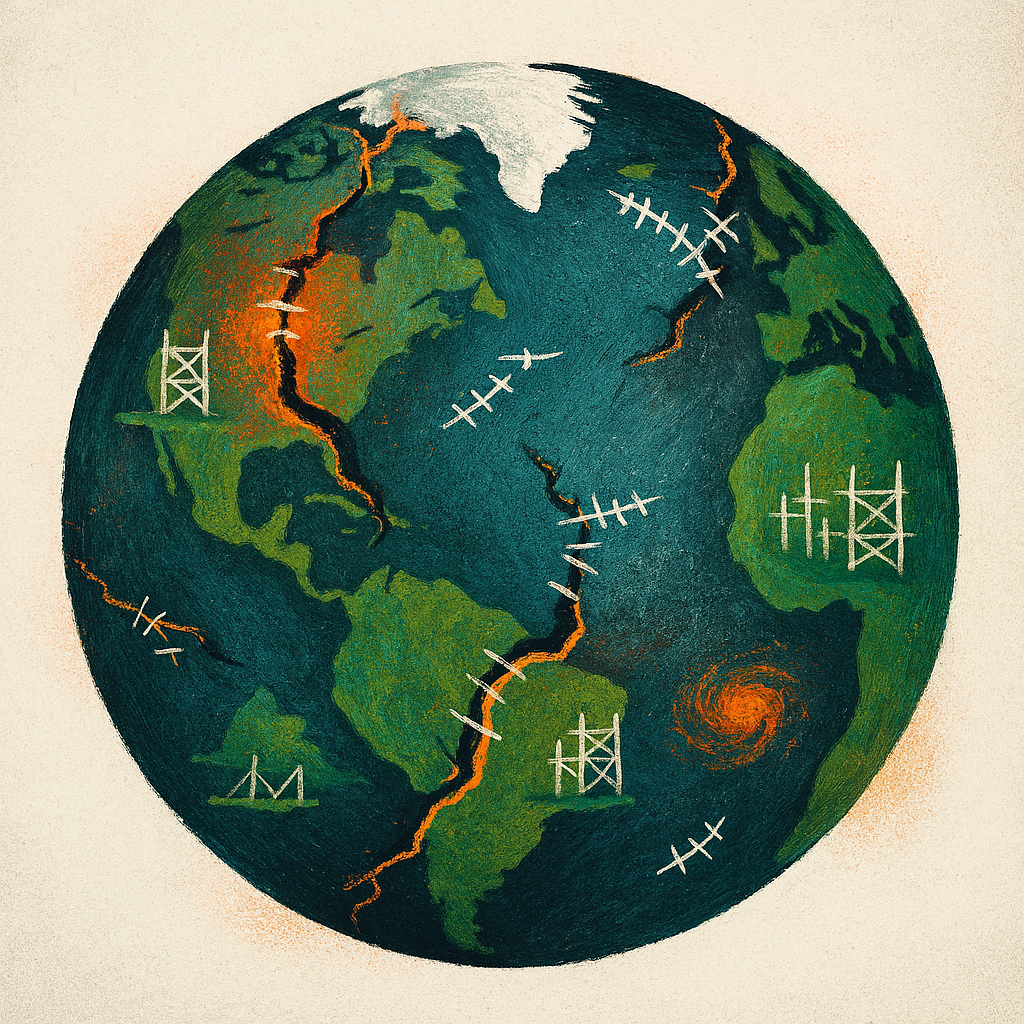
We are concerned. We are witnessing climate change disasters unfold in real time — each one linked, each one escalating. Hurricane Melissa, accelerating permafrost thaw, glacial retreat, destructive wildfires, weakening Amazon moisture transport, Antarctic grounding-line loss, coral reef collapse, and rising emissions are not isolated events. They are thresholds crossed and signals of what’s approaching.
If humanity does not begin immediate, disciplined, and coordinated action, we risk more deadly storms, further sea ice loss, intensified wildfires, increased permafrost thawing, the complete loss of Earth’s coral reefs, the collapse of the AMOC, and the submergence of coastal cities — if not worse.
The question is no longer whether we have the technology to prevent worst-case outcomes — we do. The question is whether we will act. Whether we will choose to prevent what can still be avoided. Whether we will come together — as people, and with AI — to stop cascading disasters before they become irreversible.